" ". The Smiling Cat: Traditional Blocks
Showing posts with label Traditional Blocks. Show all posts

Saturday, September 7, 2013

Thrifty Blue Pinstripe Pinwheels Made from Men’s Shirting


I love men’s cotton shirting fabric, and (don’t laugh) I always look through the men’s shirt section when thrifty shopping.  I find quite a few good quality, cotton dress shirts that don’t show much, if any wear, and only cost around $5.00.  The colors may be muted, but come in delightful large & thin stripes, paisleys, and other fun prints.  Each long sleeve shirt can be cut into five good-sized pieces:  two front pieces, two sleeves and the back.  You end up with at least a yard of good quality, usable fabric, and get several nice-sized buttons as well.

I found this pretty, medium blue with a narrow orange pinstripe cotton.  Great colors & I love the woven texture!  I paired it with a dark yellow cotton linen, left-overs from a past project, that I’d already cut into 5” squares.  Pinstripes….led to pinwheel squares. 
To make 64 (3-1/2”) pinwheels, I used: 
  •   32-5” squares of pinstripe men’s shirting- One large Men’s long-sleeve dress shirt should be plenty.
  •   32-5” squares( 5/8 to one yard) of bright yellow cotton linen
You could use this pattern to make pinwheels using pre-cut 5” Charm Squares.  You would be able to make two pinwheel squares from each 5” charm square paired with yellow, white or another neutral color.
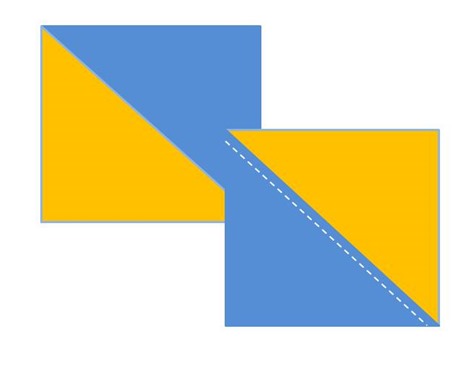
In order to make the pinwheels, I needed to make 1/2 square triangles.  The yellow linen was already cut into 5” squares, so I cut a few 5” squares of the striped fabric to experiment with some ideas.  I settled on making four 1/2 square triangle units from each 5” square pair of fabrics, using the ‘X marks the spot system’.  I began by marking a pencil line on each diagonal.
Presentation1a
After marking the X-I fed them one by one through my machine, corner to corner, chain sewing a 1/4” seam on both sides of each drawn line. Because I was cutting so many units from each square, and so much handling can pull out stitches, I did a quick backstitch at the beginning and end of each square.

Presentation1b
Quick tip:  When reaching the end of first chain, DON’T cut them apart yet!  With needle still down in last stitch, raise presser foot, turn around and then sew down the other side of the line, while they’re still attached.

 
Just pull them along, twisting and turning them right side up.  This saves time and thread!  Now cut to separate, clipping both threads at once.
After cutting them apart, I pressed them, being careful not to pull and distort the fabric.  I repeated these steps on the other diagonal:
Presentation1c
  I pressed again, using spray starch, and then cut the squares in half lengthwise……


…………………………………………………………………………………and cross-wise.
Presentation1d
Lastly, I cut the resulting squares in half by cutting on the pencil line.
Presentation1e
After cutting them apart, I carefully pressed the units open, pressing toward the blue cotton.  I noticed that even though this is a simple, even stripe-I got four distinctly different 1/2 square triangles, which were approximately 2” square.   So, I sorted them into four stacks, and arranged these stacks in the correct placement of the pinwheel, keeping the stripes going the same direction.
  
I finished one block as a “master” and kept it to compare each new block to as I continued.  I started with the top row of units, flipping the right unit over the left unit, right sides together, lining up the diagonal seams.  I stacked the pairs, keeping the side to be sewn to the rightPresentation1fI chained stitched the units together, using a 1/4” seam, then pressed open.  Because the yellow linen is thicker, I pressed toward the blue stripe fabric, and trimmed off the little triangle ‘dog ears’.  I did the same with the bottom row.  Then, I matched the center seams and sewed the top row to the bottom row.  This time I pressed the seams open.


I trimmed the pinwheels to 3-1/2” square.  Pretty-  huh?!


To connect the pinwheels.  I cut 1” strips of an orange cotton as sashing.  I divided the pinwheels into two piles, and started by sewing a sashing strip to the bottom of the first pile. I pressed toward the sashing, then added the second pinwheel to the opposite side of the orange sashing.
 
Again, I divided the units into two piles, and connected these units with another strip of orange sashing.  These completed blocks were 7” square.  Then, I cut 1-1/2” sashing strips of a solid blue cotton.  I repeated the same steps as with the orange sashing to join the pinwheel blocks together, to form 4-pinwheel blocks.  These measured 14-1/2” square.


I ended up with four of the 4-pinwheel blocks, and connected them with more of the blue sashing.  I used the blue sashing as the first border.  Then added a 1/2” yellow border, and a 1-1/2” border of a pale blue cotton that I decided to use as the backing.  Another border of the remains of the 1/2” orange sashing, and then the last of the 1-1/2” medium blue sashing.  This project sure made a dent in my scrap stash, and I love the bright colors!


Here it is layered, pinned and ready for quilting.  I haven’t quite decided how to finish this project.  But, I’ve just been using up some of my ‘left-over’ fabrics, so why not experiment a bit?   
That’s all for now-Carole

Sunday, March 24, 2013

Springtime, Butterflies & New Pillow Covers


DSC01534 (1)
In the days before central heat & air, preparing the house for summer involved more than just turning a dial from heat to cool.  Storm windows were replaced with screens, heavy curtains were exchanged for lighter ones that didn’t block welcome breezes.  Lightweight cotton spreads were were put on the beds, while the quilts were stored until fall.  Now many of these practices have become a decorating choice rather than a necessity.  Along with cotton bed spreads- changing table linens, slipcovers & pillow covers are easy, and inexpensive ways to brighten your home’s decor for Spring.  Pillow covers, in particular, are versatile and so easy to make.  The covers can be filled with an insert, or can be used to cover an old pillow.  The following is three variations of a basic pillow cover pattern which can be found HERE.


This first pillow cover is made of a water color cotton print, it looks like melted crayons to me.  It’s just the basic pattern, but with large, decorative buttons on the front, instead of small utility buttons on the back.


This second pillow cover uses a foundation- pieced butterfly pattern.  Foundation piecing may seem complicated, but this is very easy.
  
 
First just print out this Butterfly  PATTERN and trace it on to plain, white cotton or light-colored scrap fabric.  You could also just paper-piece it if you like.  I prefer using a fabric foundation-and I always seem to have fabric scraps I need to use up.

 
When foundation piecing, the fabric is placed on the front, but is stitched on the printed lines on the back.  So, to begin, cover the #1 section with a small piece of white fabric, facing right side out. Then, cut a piece of the butterfly fabric that’s a bit bigger than section #2.  With the right side of the fabric facing toward the white fabric, line up the edge of the #2 fabric with the line between #1 & #2, overlapping it.


Sew on the line between #1 and #2.  Then fold open and press.


Next, cut a piece to cover section #3, position as before and sew on the line between #2 and #3.


Again, fold open and press.


Continue with this until all the sections are covered.  Then sew the other two pieces of the butterfly, and sew these together to make a complete butterfly.


Press seams open on the back.  For a more detailed explanation of foundation piecing, see my previous post, Rainbow Chevron Block Table Runner -Here.


I made three of these little, 4” butterflies from different fabrics, and stitched on the little, black antennas, and decorated the wings with buttons.
 
I then framed the butterflies with blue strips and thinner pink strips.  I finished by sewing a blue, pink & white floral fabric to the top & bottom.


Also used this white & floral fabric for the back, completed with four white buttons.  Again, I finished the pillow cover using the basic pattern which can be found  HERE.


This last pillow cover is a simple patchwork pattern of vintage cotton & linen, though it does involve a little fussy cutting.


To fussy cut is to target and cut a specific motif that's printed on fabric, rather than randomly cutting yardage as we normally do.  I wanted to use the white embroidery of this peach-colored vintage cotton  This is usually done using a template-there are many kinds of these available.  I usually just make my own.  I save clear, plastic coffee lids to make templates for fussy-cutting.  I cut a paper shape, tape the shape on the coffee lid, then cut it out.  After I decide what area I want to use, I trace around the template with pencil, and cut it out with scissors.  Usually the goal is to cut identical shapes, but I cut these randomly.  

 
After I cut as many of the 2-1/2” squares of the coral cotton as I could, I matched them with 2-1/2” cotton linen squares.


Next, I chain-stitched them together using a 1/4” seam allowance.


I hunted through my fabric stash & found a few other fabrics to add to the pattern, green gingham, a yellow plaid, and a floral, vintage cotton handkerchief.


Next, I cut the other fabrics into 2-1/2” squares, and arranged them randomly-then sewed them together, again using 1/4” seam.  It’s funny but, I’ve found it’s harder to arrange patches randomly, then to follow a pattern.  You’d think it would be the other way around.


In the end, I had a 18-1/2” square.  I layered it with thin cotton batting and a cream colored backing.  I decided to try using a twin needle that I bought for a different project, but hadn’t used.  It was much easier to set-up & use than I’d thought.  Happy with the way it looked-I stitched down each seam.  I started in the middle, and worked my way out.  Also, I kept turning the square around so that it didn’t start to curve in one direction. 


Happy with the pillow top, I finished the cover using this PATTERN
    

Well, that’s all for now.  Please leave a comment so I know that you stopped by- Carole
Blogger Labels: Springtime,Butterflies,cotton,decorating,foundation,easy pattern,fabric,paper piecing,piecing,scrap fabric,buttons,home decor,fabric strips,fussy cutting,simple pattern,motif,embroidery,template,pillow pattern,sewing pattern,vintage fabric,spring colors,housewares,handkerchief,quilted,SewEtcetera,Carole May,quilt block,variations,pattern pieces,quilting,fabrics,patchwork,templates,patches,pillow cover,top stitching,twin needles,linen

Saturday, July 14, 2012

Rainbow Chevron Block Table runner~


I love rainbows, they always make me smile!  Lately I’ve been seeing them everywhere-from cake decorating to home décor.  Big, bold slices of color.  Many of the new fabrics on my wish list are jewel tones.  I particularly like the contrast of the bright colors against a clean, white background.  So, I’ve been experimenting with rainbows and started using some of the fabrics I’ve stashed away, because I didn’t quite know how to use them.  Colors like bright oranges & dark purples.  I’m usually drawn to softer colors.  Anyway, I came across a full-size quilt pattern with the 1/2 square log cabin, chevron pattern, set on point in rows and connected with small black & white checker-boards.  It inspired me to create this little table runner.  I foundation pieced the little chevrons, and used black, baby ric rac to connect them.  The ric rac gives a similar look with out having to piece little, teeny, tiny checker-boards.  I like piecing little details-but there’s no need to go crazy!  I don’t know if this project is suitable for beginners, but I’m including step-by-step instructions with lots of pictures.  If you have any questions, you can always e-mail me or leave a comment.
DSC08647 (2)